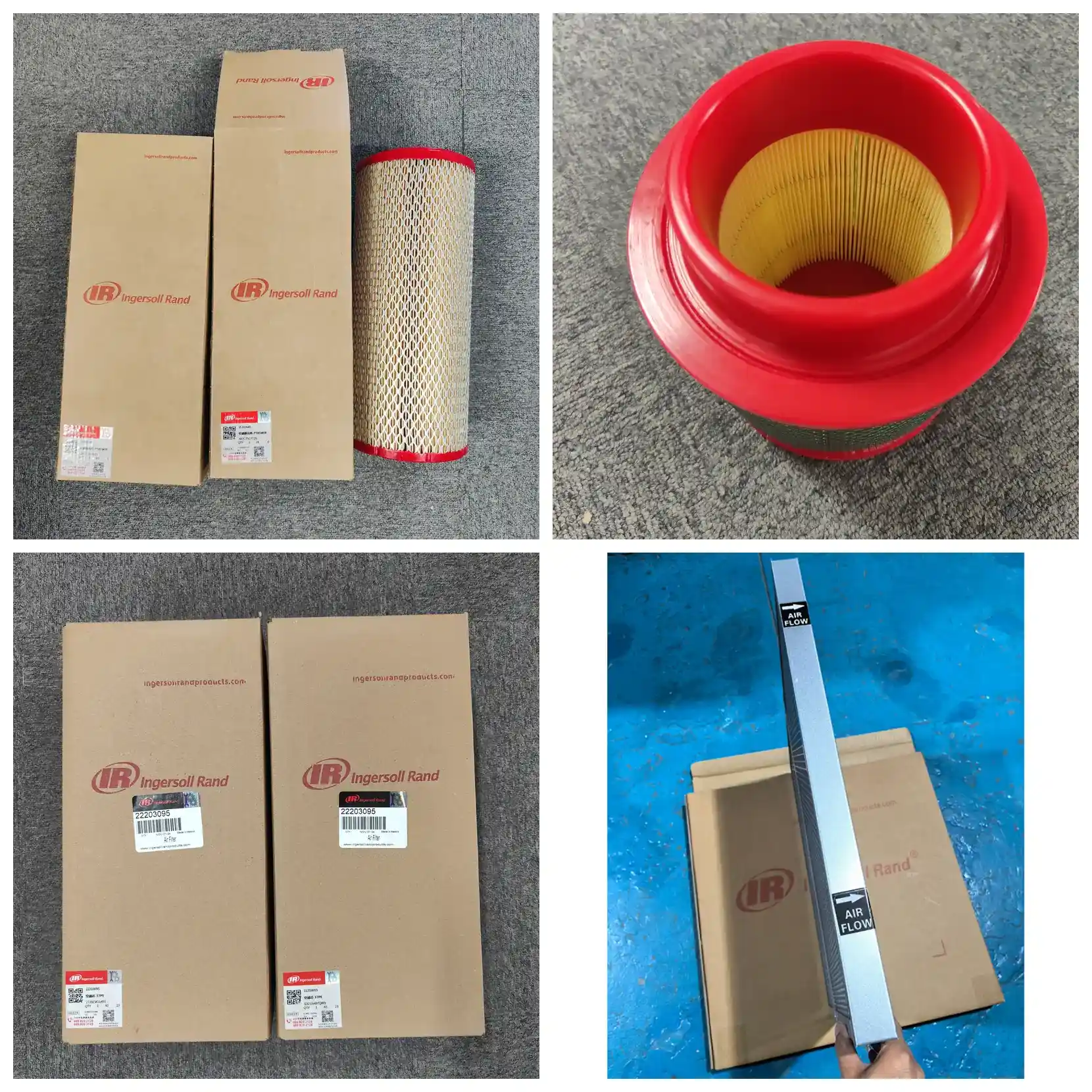
Product
Ingersoll Rand 47722477001 Air Filter Element | Centrifugal MSG Centac Intake Filter
Genuine-style Ingersoll Rand 47722477001 intake air filter element for MSG TURBO-AIR and MSG Centac centrifugal compressors (item code P675, group C675). 5–10 μm filtration, ≥98% efficiency, cellulose pleated media, −10 to +80 °C. Export-ready with part-number verification support.
- Export packaging & documentation support
- OEM / ODM customization available
- Sample and bulk order workflow
Product Overview
47722477001 is the intake air filter element for Ingersoll Rand centrifugal air compressors. It mounts inside the intake filter assembly, upstream of the centrifugal impeller inlet. As the first barrier in the air path, it captures dust, grit and fibers before they reach the impeller and intercooler — critical on a 100% oil-free machine (ISO 8573-1 Class 0), where no lubricant carries particles away and deposits can shift impeller balance.
This part belongs to the Ingersoll Rand centrifugal product line (CC), item-level model code P675, compressor group designation C675. It fits MSG TURBO-AIR and MSG Centac series machines and their packaged systems.
| Item | Value |
|---|---|
| Part number | 47722477001 |
| Description | Air Filter Element |
| Brand | Ingersoll Rand |
| Application | Ingersoll Rand centrifugal compressors (MSG TURBO-AIR / MSG Centac series) and packaged systems |
| Product line | Centrifugal (CC) |
| Filtration rating | 5–10 μm |
| Filtration efficiency | ≥98% for particles ≥5 μm |
| Recommended change interval | 2,000 hours or 3 months |
Technical Specifications
Filtration performance
| Parameter | Value / Notes |
|---|---|
| Filtration rating | 5–10 μm |
| Filtration efficiency | ≥98% for particles ≥5 μm |
| Filter class | Characterized per ISO 5011 by efficiency, restriction and dust holding capacity; HVAC classes (G4/F7) do not apply |
Flow and restriction
| Parameter | Value / Notes |
|---|---|
| Rated air flow | Must exceed machine rated intake flow; select against discharge flow corrected for intake temperature and altitude |
| Initial pressure drop | Approx. 0.3–0.5 kPa (clean, new element) |
| Operating differential | Rises with dust loading; typical range approx. 0.5–1.5 kPa |
| Alarm / final restriction | Typical change threshold approx. 1.5–2.5 kPa; on centrifugal machines the intake depression gauge reading is the final criterion |
| Restriction vs. energy | Each 1 kPa of intake restriction raises compression ratio by approx. 1%, increasing machine energy use by approx. 1.0% |
| Intake restriction | Compression ratio | Energy increase |
|---|---|---|
| 0 kPa (new element) | 9.39 | Baseline |
| 0.5 kPa | 9.44 | +0.5% |
| 1.0 kPa | 9.49 | +1.0% |
| 1.5 kPa | 9.53 | +1.5% |
| 2.0 kPa | 9.58 | +2.0% |
| 2.5 kPa | 9.63 | +2.5% |
Across one element's service life, intake restriction climbs by more than 2 kPa, adding roughly 2% to energy consumption. On high-power, continuously running centrifugal machines, that energy penalty typically exceeds the price of the element — running past the restriction threshold is not economical.
Construction and materials
| Parameter | Value / Notes |
|---|---|
| Filter media | Cellulose (wood-pulp fiber) filter paper, pleated construction |
| Media weight | Approx. 130 g/m² |
| Inner / outer support | Galvanized steel perforated cages, supporting the pleats on both sides |
| End caps | Metal or polyurethane end caps, bonded to the media |
| Seal | Polyurethane or NBR seal, integral with or separate from the end cap |
| Bonding | Polyurethane adhesive for media-to-cap and cage fixing and edge sealing |
Operating limits
| Parameter | Value / Notes |
|---|---|
| Operating temperature | −10 °C to +80 °C |
| Relative humidity | ≤90% RH, non-condensing |
| Collapse resistance | Standard design withstands a differential pressure across the media of not less than 5 kPa without deformation |
| Function | Intake-stage filtration for oil-free centrifugal machines, working with the downstream clean filter to protect air quality |
Service life and storage
| Parameter | Value / Notes |
|---|---|
| Service life | 2,000 hours or 3 months, whichever comes first |
| High-dust environments | Shorten hours accordingly (e.g. approx. 1,500 hours), with the time limit moved up as well |
| Shelf life | Use within 24 months; store dry, ventilated and out of direct light, protected from moisture and crushing |
| Change criteria | Intake depression gauge over limit, or media damage, adhesive failure, or flattened seal face |
Applicable standards
| Standard | Notes |
|---|---|
| ISO 5011 | Test method for intake filter efficiency and dust holding capacity — the performance basis for this class of air filter |
| ISO 8573-1 | Compressed air quality classes; this machine class is Class 0 (100% oil-free) |
| Note | ISO 2941 / 2942 / 2943 / 3723 / 3724 are hydraulic filter standards covering pressure, burst and filtration characteristics and do not apply to air filters; they should not be used as air filter performance references |
Installation and Maintenance Steps
- Confirm machine status and spare. Check the machine nameplate model and group designation, and confirm the new element matches the old part number. Have the new element, lint-free cloths and tools ready.
- Shut down, depressurize, isolate. Follow the shutdown procedure and wait for full depressurization — centrifugal machines have rotational inertia, so wait until the controller confirms zero speed. Lock out and tag out the main power. This step is mandatory.
- Verify the old part before dismantling. Read the stamped part number and mounting position on the old element's end cap and confirm it matches the replacement before opening the intake filter assembly. Intake and clean-stage elements use different part numbers — this step prevents mis-installation.
- Remove and inspect the old element. Lift it out vertically and check dust distribution and media condition. Replace immediately if the media is torn or perforated, the end cap has debonded, or the seal face is flattened — even if the interval has not been reached. Black oily sludge on the outer surface indicates abnormal oil mist in the intake and warrants an upstream check.
- Clean the assembly interior. Wipe the inner walls and base with a lint-free cloth. Do not blow compressed air into the assembly — it drives dust into the intake passage. Confirm no loose dust remains and the seal face is flat and clear.
- Install the new element. Fit it in the same orientation and position as the old one, paying attention to seal face direction and clamping method. The element should seat without movement and the seal face should be evenly compressed around its circumference.
- Reassemble and confirm sealing. Refit the cover or clamp and tighten evenly per machine requirements. Check that the intake depression gauge impulse line is clear — a blocked line gives a false "clean" reading and is a common source of misjudgment.
- Reset, test run, record. Reset the maintenance timer, start the machine unloaded and observe the intake depression gauge and running sound. The gauge should sit within the machine's allowable range with no abnormal whine (whine usually indicates seal bypass). Record machine hours at change as the start of the next interval.
Frequently Asked Questions
Q1: Which machines use 47722477001?
Ingersoll Rand centrifugal air compressors — MSG TURBO-AIR and MSG Centac series and their packaged systems (item-level model code P675, group designation C675). These are 100% oil-free designs. For a specific machine, verify against the nameplate and the old element's part number.
Q2: Can it be used on an oil-flooded screw compressor?
Not recommended. This element belongs to the centrifugal product line and its dimensions and interface are designed for centrifugal intake assemblies. Oil-flooded screw machines use a different part number system, and cross-use cannot guarantee sealing or filtration performance.
Q3: What is the change interval?
The standard interval is 2,000 hours or 3 months, whichever comes first. In high-dust environments (cement, quarrying, mining, metalworking) shorten to approximately 1,500 hours. The intake depression gauge reading is the final criterion — change when it exceeds the limit, regardless of running hours.
Q4: Why is intake filtration more demanding on centrifugal machines than screw machines?
Centrifugal machines are oil-free, so no lubricant carries particles away and deposits settle on the high-speed impeller and intercooler surfaces. Impeller fouling shifts dynamic balance and requires a shutdown for rotor correction. Oil-flooded screw machines have an oil film that carries some contaminants away, giving more tolerance.
Q5: Why are dimensions not listed?
Centrifugal machines are supplied as project-based packages, so intake assembly dimensions vary between groups and package scopes within the same series; quoting a single dimension can mislead buyers. Measure the old element's outer diameter, inner diameter, overall height and seal type, or send photos and the machine nameplate so we can cross-check by part number.
Q6: What happens when intake restriction rises?
Energy use increases — each 1 kPa of intake restriction raises the compression ratio by about 1% and machine energy use by about 1% — and intake volume falls, reducing discharge flow. Running past the change threshold costs more in electricity than the element saves.
Q7: Can an alternative element be used?
Yes, but verify three points: filtration rating, end cap seal type and dimensions. If an alternative's seal type does not match the original, bypass occurs — on an oil-free centrifugal machine, bypass means particles reach the impeller directly, a higher risk than on oil-flooded machines. Provide old-element photos and this part number when sourcing alternatives.
Q8: What if there is abnormal whining after installation?
Whining usually indicates seal bypass — the element is not fully seated, the seal face is deformed, or the seal is missing. Shut down and recheck seating and seal condition. Also check the intake depression gauge impulse line for blockage to avoid misdiagnosis.
Q9: How should spares be stored?
Store dry, ventilated and out of direct light, protected from moisture, rain and heavy loads. Moisture reduces media strength, and compression deforms the sealing fit. Use within 24 months.
Q10: Which elements in the same series are easily confused?
In the Ingersoll Rand centrifugal line, one machine often carries both an intake filter and a downstream clean filter, with different part numbers and mounting positions. Confirm whether you need the intake or clean stage before ordering — filtration rating, media and seal type differ between the two.
Compatible Machines and Part Number Verification
| Item | Detail |
|---|---|
| Machine type | Centrifugal air compressor |
| Product line | Ingersoll Rand centrifugal line (CC) |
| Series | MSG TURBO-AIR / MSG Centac |
| Item-level model code | P675 |
| Group designation | C675 |
| Air quality class | 100% oil-free, ISO 8573-1 Class 0 |
| Typical applications | Continuous clean oil-free air supply (food and beverage, pharmaceutical, electronics, textiles, pneumatic conveying) |
Representative model families (family-level reference; individual fit must be verified by serial number): MSG TURBO-AIR TA / NX packaged units; MSG Centac standard pressure C series (C400, C700, C800, C1000, C3000 and others); MSG Centac high pressure C750, C1050, 2CII, 3C, 4C and similar; and the dryers, filters and receivers packaged with these machines.
Why selection must be verified by part number, not machine model
Centrifugal machines are supplied as project-based packages: intake assembly configuration, downstream treatment scope and interface dimensions can differ between projects for the same machine, and each machine carries both an intake-stage and a downstream clean-stage element with different part numbers. Select first by the part number stamped on the old element, second by the machine nameplate, and third by mounting position.
Three-step verification
- Read the stamped part number on the old element's end cap or cage and compare with the ordered number.
- Read the model and group designation on the machine nameplate and compare with the machine parts manual.
- Confirm the old element's mounting position (intake stage or clean stage) — the two are not interchangeable.
If the three steps do not confirm fit, send the machine nameplate photo, old-element photos including the stamped part number, and the mounting position. We will cross-check by part number before confirming.
Cross-series note: centrifugal machine elements and oil-flooded screw machine elements belong to different part number systems and cannot be interchanged. Screw compressor air filters are dimensioned for external intake assemblies, and direct substitution will cause seal failure.
Related Parts
| Part | Part number | Function | Check points |
|---|---|---|---|
| Sterile filter element | 47722478001 | Downstream sterile-grade element removing microorganisms and fine particles for higher-purity air requirements | Belongs to a different filtration stage; not interchangeable with the intake element — confirm position at change |
| Air filter assembly (housing) | — | Housing that holds and locates the intake element | Inspect clamps, seal faces and outlet end for deformation or corrosion |
| Intake depression / differential gauge | — | Displays intake restriction and is the final criterion for the change interval | Periodically check the impulse line for blockage — a blocked line gives a false "clean" reading |
| Seals | — | Prevent bypass between element and assembly | Inspect together with the element; replace if flattened, hardened or missing |
| Machine lubricant and oil filter | — | For the gearbox and bearing lubrication system (not compression chamber oil) | Change per the machine parts manual schedule; inspect alongside the intake element |
Recommended grouping: inspect the intake element, downstream clean element and seals together, and decide each replacement on its own criteria. The intake and downstream clean elements have different intervals (the downstream element is usually judged by cleanliness requirement rather than dust loading), so they need not be changed together.
For specific part numbers: items marked "—" above should be confirmed against the machine-specific parts manual. Centrifugal machines are project-based packages, and listed companion part numbers correspond to the serial numbers of the machines they were supplied with; they should not be applied across projects.
Ordering and Supply
We supply this element to importers, distributors and maintenance contractors serving Europe and North America. Send the part number 47722477001, the machine nameplate and a photo of the old element with its stamped number, and we will confirm fit and provide a quotation. Datasheet and sample requests are welcome.